Walk into any electronics store in India — or scroll through any online sale — and two names dominate the smartwatch shelves: Noise and boAt. Both are homegrown Indian brands, both sell feature-packed smartwatches at prices that were unthinkable five years ago, and both have fiercely loyal fans. So in the Noise vs boAt smartwatch debate, which is better in India? If you landed here searching for “noise vs boat smartwatch which is better india”, this comparison gives you the full picture before you spend a rupee. The honest answer is that neither brand wins outright — they win at different things, for different buyers.
This comparison breaks down the two brands across the seven factors that actually matter: display, battery life, health tracking, Bluetooth calling, build quality, app experience, and value for money. We will keep it practical and India-specific, talk in typical ranges rather than cherry-picked specs, and end with a clear verdict for each type of buyer.
In this guide
- Brand Overview: Noise and boAt in India
- Display Quality: Brightness, Size and AMOLED vs LCD
- Battery Life: The Real-World Story
- Health and Fitness Tracking Compared
- Bluetooth Calling and Everyday Usability
- Noise vs boAt Smartwatch: Value for Money in India
- The Verdict: Which Should You Buy?
- Frequently Asked Questions
Brand Overview: Noise and boAt in India
Both brands were born in India and built their empires on the same insight: Indian buyers want flagship-style features at budget prices. boAt (by Imagine Marketing) started with audio products and expanded into wearables, becoming one of the largest wearable brands in the world by volume. Noise (by Nexxbase) focused on wearables earlier and built a reputation for pushing display technology — like AMOLED screens — into lower price brackets faster than competitors.
Their product lineups look similar at a glance: dozens of models spread across budget (roughly ₹1,000–₹2,000), mid-range (roughly ₹2,000–₹4,000), and premium-budget (roughly ₹4,000–₹7,000) segments. Both refresh their lineups constantly, which means last season’s models often get steep discounts during online sales — frequently the best time to buy either brand.
Service networks are a practical consideration. Both brands have expanded service centre coverage across Indian cities, though experiences vary by location. Before buying, it is worth checking that your city has accessible service for the brand you choose — a smartwatch with a dead battery and no nearby service centre is just an expensive bracelet. Both brands typically offer a one-year warranty, which is standard for the segment.
One thing to understand upfront: at these prices, neither brand makes a “perfect” smartwatch. Every model involves trade-offs. The skill is in picking the model whose trade-offs do not affect how you use a watch. That is what the rest of this comparison is for.
Display Quality: Brightness, Size and AMOLED vs LCD
The display is the first thing you notice and the thing you look at hundreds of times a day, so it deserves top billing. This is also the area where Noise has historically held a slight edge: Noise was aggressive about bringing AMOLED displays — with their deep blacks, punchy colours, and always-on display options — into the ₹2,500–₹4,000 range, while boAt took longer to follow at the same prices.
That gap has narrowed. Both brands now offer AMOLED models in their mid-range lineups, and both still sell plenty of TFT/LCD models at the budget end. As a buyer, the rule is simple: if your budget stretches to an AMOLED model from either brand, take it. The difference in readability, especially outdoors, is immediately visible. Indian sunlight is brutal on dim screens, and AMOLED’s higher typical brightness plus better contrast makes the watch usable in conditions where a budget LCD washes out.
Screen size is mostly a matter of wrist size and taste — both brands offer models from compact (around 1.8 inches) to large (around 2 inches). Larger screens show more text in notifications and make touch targets easier, but they look oversized on slim wrists and drain battery slightly faster. If possible, try the size on your wrist in a store before ordering online.
Also check the peak brightness figure on the spec sheet, usually quoted in nits. For comfortable outdoor use in India, look for 500 nits or more; 600+ is genuinely good at this price. And be realistic about always-on display: it looks great but typically cuts battery life noticeably, so many owners end up turning it off anyway.
Battery Life: The Real-World Story
Battery claims in this segment should be read with healthy scepticism. A box that promises “7 days battery life” usually means 7 days with minimal usage: no Bluetooth calling, no always-on display, limited notifications, no continuous heart-rate monitoring. Turn on the features you actually bought the watch for, and real-world life is typically 2–4 days for most models from both brands.
In general, boAt and Noise are evenly matched here — battery life depends far more on the specific model’s display type, battery capacity, and which features you enable than on the brand badge. AMOLED models from both brands tend to last slightly less than their LCD siblings with always-on enabled, but slightly more with it off, because black pixels on AMOLED draw almost no power.
Bluetooth calling is the single biggest battery drain on modern budget smartwatches. If you take several calls a day on your watch, expect to charge every 1–2 days regardless of brand. If you mainly use the watch for notifications and fitness tracking, 4–5 days is realistic for many models. Manage your expectations around your usage, not the marketing number.
Charging convenience matters too. Most models from both brands now use magnetic pogo-pin chargers or USB-based docks, with a full charge taking roughly 1.5–2.5 hours. Proprietary chargers are annoying to replace if lost, so keep the charger somewhere you will not lose it — replacements are available online but rarely as cheap as you would hope.
Health and Fitness Tracking Compared
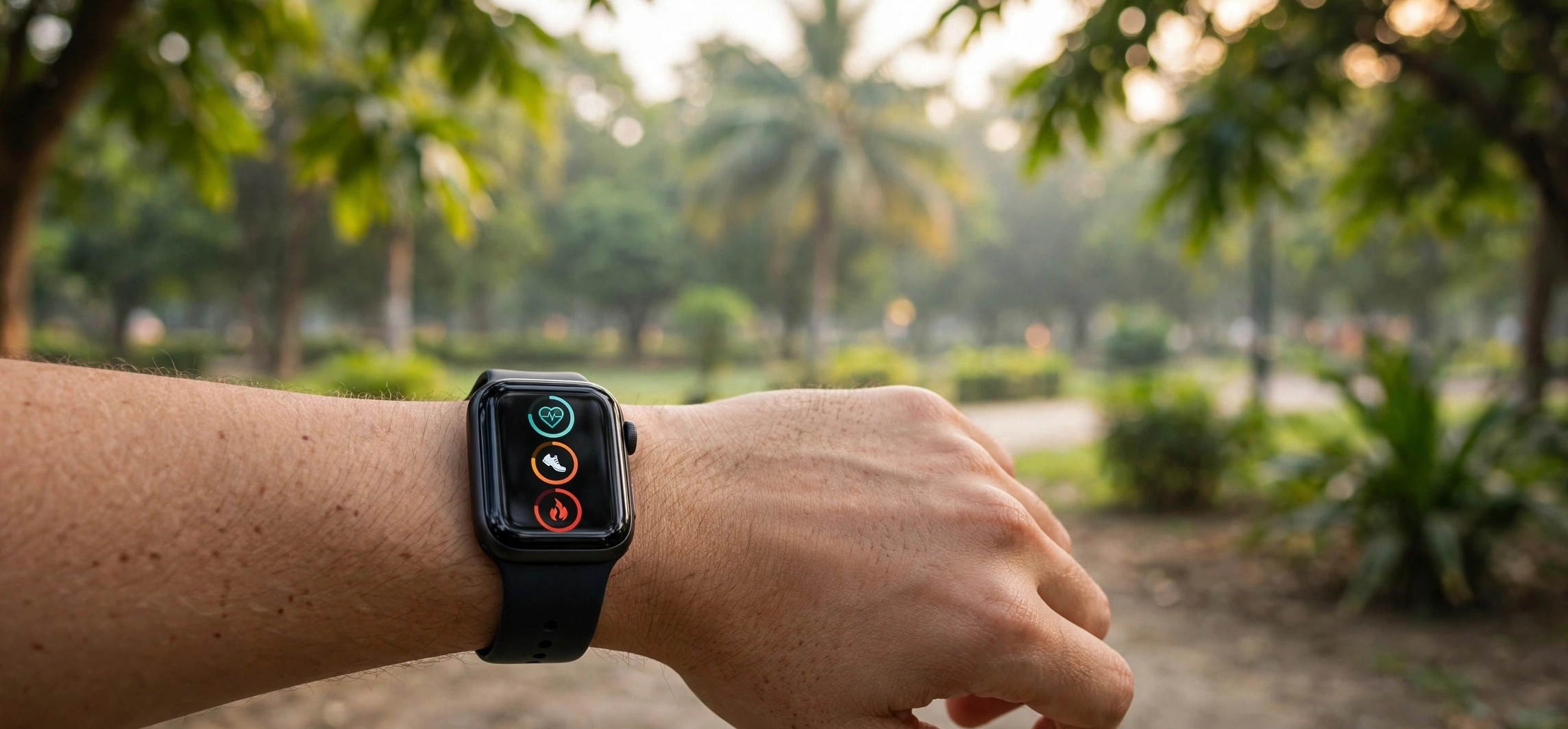
Both brands offer the standard suite: heart-rate monitoring, SpO2 (blood oxygen), sleep tracking, step counting, and 100+ sport modes. On paper, the lists are nearly identical. In practice, there are nuances worth knowing.
First, treat all budget smartwatch health data as indicative, not medical. Heart-rate readings during steady activity are reasonably accurate on both brands’ recent models, but SpO2 and sleep-stage breakdowns are estimates with meaningful error margins. Neither brand’s watch replaces a medical device, and both brands say so in their fine print. Use the trends (resting heart rate over weeks, sleep duration patterns) rather than obsessing over single readings.
Second, sensor quality varies more by model and price than by brand. A ₹5,000 model from either brand will generally track more accurately than a ₹1,500 model from either brand, because the pricier model has better sensors and newer algorithms. If fitness tracking is your priority, put your money into a mid-range model rather than the cheapest option with the longest feature list.
Third, GPS is the feature to watch for if you run or cycle outdoors. Many budget models lack built-in GPS and rely on your phone’s GPS instead — fine if you always carry your phone, useless if you want to leave it behind. Models with built-in GPS cost more from both brands, so decide whether you need it before paying for it.
Bluetooth Calling and Everyday Usability
Bluetooth calling — answering phone calls on your wrist — has become a headline feature, and both brands implement it similarly: the watch pairs with your phone over Bluetooth, uses its own speaker and microphone, and shows a dial pad for outgoing calls. In quiet rooms, call quality is acceptable on recent models from both brands. In noisy Indian traffic, both struggle — the microphones are small and noise cancellation is basic. If you take a lot of calls, enabling Wi-Fi calling on your phone improves the underlying call stability that your watch relies on.
Everyday usability differences are subtle but real. Notification handling is comparable: both show message previews, both let you reject calls with a preset SMS reply, and neither offers full reply typing (the screens are too small for it to be practical). If a message needs a proper reply you cannot type on the watch, you can always schedule a WhatsApp message from your phone to handle it later. Watch face selection is generous on both, with hundreds of options in their companion apps, though quality varies wildly — expect to try a dozen before finding one you like.
Water resistance is worth a specific mention. Most models from both brands carry an IP67 or IP68 rating, which means rain, sweat, and hand-washing are fine. Neither is meant for swimming unless explicitly rated for it (look for 3ATM/5ATM ratings). Do not take a merely “splash-proof” watch into a pool, regardless of brand.
One practical tip: keep your watch’s firmware updated. Both brands push updates that fix bugs, improve battery life, and occasionally add watch faces. Many “my watch is buggy” complaints trace back to firmware that is several versions out of date.
Noise vs boAt Smartwatch: Value for Money in India
This is where the Noise vs boAt smartwatch comparison gets most interesting for Indian buyers, because the two brands price and discount differently. boAt tends to be more aggressive with headline pricing and sale discounts — its watches frequently appear at eye-catching prices during Flipkart and Amazon sales. Noise tends to hold prices steadier but packs slightly better displays into the same bracket.
As a rough pattern (prices move constantly, so verify at purchase time): in the budget band around ₹1,000–₹2,000, both offer capable basics and the choice comes down to which specific model’s display and battery reviewers prefer that month. In the mid band around ₹2,500–₹4,500 — the sweet spot for most buyers — Noise often gives you AMOLED at a slightly lower price point, while boAt counters with strong calling features and loud marketing. Above ₹5,000, both face competition from Amazfit and Samsung’s entry models, and the “which is better” question starts to include those brands too.
The smartest buying strategy applies to both: never pay the launch price. Both brands discount heavily within weeks of launch and during every major sale. Shortlist 2–3 models, set price alerts, and buy during a sale. Also compare the effective price after bank offers and coupons, not just the listed discount.
| Factor | Noise | boAt |
|---|---|---|
| Display tech per rupee | Slight edge — earlier AMOLED adoption in mid-range | Caught up; strong options now |
| Battery life | Comparable; depends on model, not brand | Comparable; depends on model, not brand |
| Health tracking | Comparable sensor suites | Comparable sensor suites |
| Bluetooth calling | Good on recent models | Good on recent models; heavily marketed |
| Pricing and discounts | Steadier pricing | More aggressive sale pricing |
| Service network | Growing; check your city | Growing; check your city |
The Verdict: Which Should You Buy?
After comparing across every major factor, here is the practical verdict. Choose Noise if display quality is your top priority and you want the best screen your budget can buy — Noise’s mid-range AMOLED models remain the value champions for screen lovers. Choose boAt if you find a model on a deep sale that undercuts the equivalent Noise on price, or if you prefer boAt’s companion app and ecosystem (especially if you already own boAt audio products).
But the more honest advice is this: at any given moment, the specific model matters more than the brand. A well-reviewed ₹3,000 Noise beats a mediocre ₹3,000 boAt, and vice versa. Shortlist by features first (AMOLED? Bluetooth calling? built-in GPS?), then compare the 2–3 models that meet your criteria, then buy whichever is cheaper during a sale. Brand loyalty in this segment mostly benefits the brands, not you.
And keep perspective on what a budget smartwatch is. It is a notification mirror, a basic fitness tracker, and a convenient way to take calls — not a medical device, not a phone replacement. Buy the features you will actually use, ignore the 150 sport modes you will never open, and you will be happy with either brand. If you need to keep your phone charged through long days of Bluetooth-connected watch use, a 20000mAh power bank under ₹1500 is a sensible companion purchase.
Frequently Asked Questions
Which is better, Noise or boAt smartwatch?
Neither brand is universally better. Noise has historically offered slightly better displays per rupee in the mid-range, while boAt is often more aggressive on sale pricing. Compare specific models on display type, battery life, and the features you need rather than choosing by brand alone.
Are Noise and boAt smartwatches accurate for heart rate and SpO2?
Heart-rate tracking during steady activity is reasonably accurate on recent models from both brands. SpO2 and sleep-stage data should be treated as rough estimates, not medical measurements. For serious training, a dedicated fitness band or chest strap remains more reliable.
Can I answer calls on Noise and boAt smartwatches?
Yes, most recent models from both brands support Bluetooth calling — you can answer and make calls from the watch when it is connected to your phone. Call quality is fine indoors but struggles in noisy environments. Heavy calling use will reduce battery life to 1–2 days.
Do Noise and boAt watches work with both Android and iPhone?
Yes, both brands’ watches pair with Android and iOS through their companion apps. However, the experience is generally smoother on Android — some features like notification replies and music control can be limited on iPhone due to Apple’s restrictions.
How long do Noise and boAt smartwatches last?
With normal use, expect 2–3 years of good service. The battery is usually the first thing to degrade. Both brands offer a one-year warranty; check service centre availability in your city before buying, since out-of-warranty repairs can be impractical.
Should I buy an AMOLED or LCD smartwatch?
If your budget allows, choose AMOLED — the difference in outdoor readability and always-on display quality is significant, especially under harsh Indian sunlight. LCD models are fine for indoor-first use and typically cost less, but the screen is the part you interact with most, so it is worth stretching the budget.
In the end, the Noise vs boAt smartwatch question has a refreshingly simple answer for Indian buyers in 2026: pick your must-have features, shortlist 2–3 models across both brands, and buy the best-reviewed one at the best sale price. So if you are still wondering “noise vs boat smartwatch which is better india” — stop comparing logos, compare the specific models in front of you. Do that, and whichever brand you end up with, you will have made the right choice.
You can explore both brands’ current lineups on their official sites: Noise and boAt.