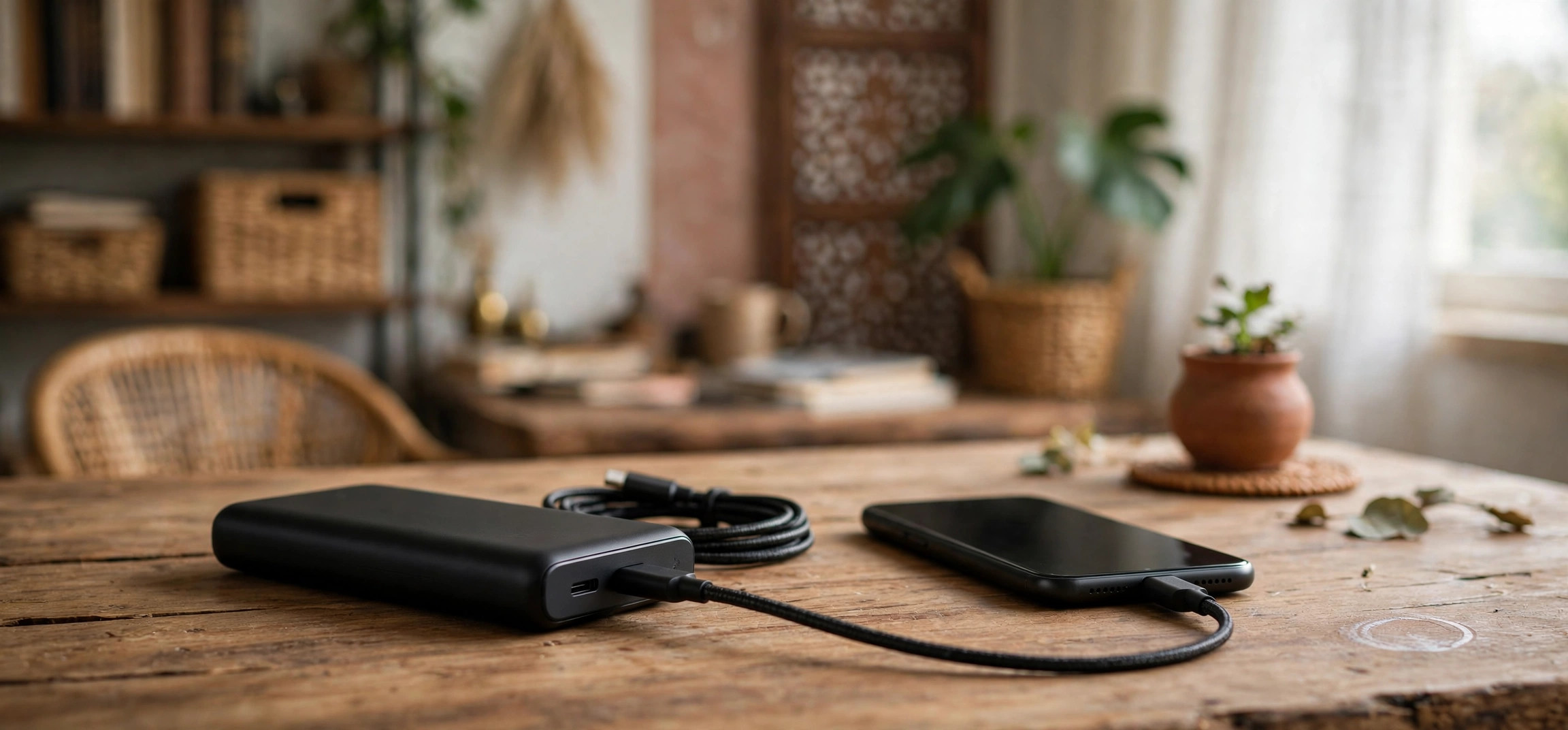
A 20000mAh power bank is the sweet spot of portable charging: enough capacity to charge your phone three to four times over, yet still portable enough to toss in a bag. And in India, intense competition has pushed prices down to the point where the best 20000mAh power bank under ₹1500 is not a compromise — it is a genuinely good product from established brands. Shoppers hunting for the best 20000mah power bank under 1500 india all want the same thing: maximum real capacity and fast charging from a brand they can trust. The catch? This segment is also flooded with inflated claims, fake capacity figures, and counterfeit units.
This guide explains what 20000mAh really means in practice, how to read charging-speed specifications honestly, why BIS certification matters, which brands to trust, and the price bands to expect. No invented models, no fake test scores — just the knowledge to buy once and buy right.
In this guide
- What Does 20000mAh Actually Mean? Real vs Rated Capacity
- Charging Speed Explained: 18W, 22.5W and What Your Phone Supports
- Best 20000mAh Power Bank Under 1500: The Buying Checklist
- Brands to Trust (and Why BIS Certification Matters)
- Price Bands: What ₹1500 Gets You in India
- Safety, Flights, and Making Your Power Bank Last
- Mistakes to Avoid
- Frequently Asked Questions
What Does 20000mAh Actually Mean? Real vs Rated Capacity
The “20000mAh” figure is the capacity of the battery cells inside the power bank, measured at the cells’ native voltage of 3.7V. But your phone charges at 5V (or higher with fast charging), and converting voltage loses energy as heat. The result: a 20000mAh power bank never delivers 20000mAh to your phone.
Here is the honest maths. The internal energy is roughly 20000mAh × 3.7V = 74Wh (watt-hours). After conversion losses (typically 10–15% in a decent unit), you get about 62–66Wh of usable energy at the output. For a phone with a 5000mAh battery (about 19Wh), that translates to roughly 3 to 3.5 full charges — not four, as naive division would suggest. For a 4500mAh phone, expect about 3.5 to 4 charges.
This is why “rated capacity” figures printed in small text on the power bank matter more than the headline number. Reputable brands print both: the cell capacity (20000mAh) and the rated output capacity (often around 12000–13000mAh at 5V). If a listing or product shows only the big number with no rated capacity, treat it with suspicion — legitimate manufacturers disclose both.
Also be aware of outright fakes. Counterfeit power banks sometimes contain a small real battery plus dead weight (sand or metal blocks) to feel heavy. A genuine 20000mAh power bank weighs roughly 400–470 grams; if a “20000mAh” unit feels suspiciously light at 250 grams, it is not what it claims to be. Buy from authorised sellers to avoid this entirely.
Charging Speed Explained: 18W, 22.5W and What Your Phone Supports
Charging speed is quoted in watts (W), and in the sub-₹1500 segment you will typically see 18W or 22.5W fast charging. What does that mean in practice? An 18W output charges most phones from 0 to 50% in roughly 30–45 minutes; 22.5W is a bit faster on phones that support it. These are meaningful, noticeable differences versus the 10W trickle of old basic power banks.
But there is a crucial detail: fast charging only works if your phone supports the same protocol. A 22.5W power bank will fast-charge a phone that supports 22.5W+ charging, but will fall back to slower speeds on phones with different protocols. Most modern Android phones support at least 18W wired charging; iPhones charge at their own pace regardless. Check your phone’s supported charging wattage before paying extra for a higher-wattage power bank — the extra watts are wasted if your phone cannot use them.
Two-way fast charging is the feature to look for: it means the power bank itself recharges quickly too. A 20000mAh unit is a big battery, and refilling it at 10W takes 10+ hours — essentially overnight-plus. With 18W input, that drops to roughly 6–7 hours. Since you will recharge the power bank itself regularly, input speed matters almost as much as output speed.
Finally, check the port selection. Most current models offer at least one USB-C port (often supporting both input and output) plus one or two USB-A ports. USB-C is the future-proof choice — it charges modern phones, and the same cable often works for your other gadgets. A power bank with only old micro-USB input in 2026 is a sign of outdated stock.
Best 20000mAh Power Bank Under 1500: The Buying Checklist
When comparing contenders for the best 20000mAh power bank under ₹1500 in India, verify these points in order:
1. BIS certification (non-negotiable)
In India, power banks are required to carry BIS (Bureau of Indian Standards) certification, shown as the ISI mark with a registration number. This is your baseline protection against shoddy cells and missing safety circuits. Never buy a power bank without it — uncertified units are where the fire-risk horror stories come from.
2. Realistic capacity disclosure
The product page or packaging should state both the cell capacity (20000mAh) and the rated output capacity. Reputable brands disclose this; evasive listings do not. As a rule of thumb, expect 3–3.5 full charges of a 5000mAh phone from a genuine 20000mAh unit.
3. Output wattage matched to your phone
18W is the sensible minimum in 2026; 22.5W is better if your phone supports it. Also confirm two-way fast charging so the power bank itself refills in reasonable time. Do not pay a premium for 65W+ output at this capacity — it is overkill for phone charging and usually signals a higher price tier anyway.
4. Port selection and cable
Look for at least one USB-C port handling both input and output, plus USB-A for older cables. A charging cable in the box is a small but welcome bonus. Pass-through charging (charging the power bank while it charges your phone) is a genuinely useful feature for overnight hotel stays with one wall socket.
5. Safety protections
The listing should mention overcharge, over-discharge, short-circuit, and temperature protection. These are standard on branded units and absent on the cheapest no-name ones. Twelve layers of protection” is marketing language — what matters is that the basic four are present and the unit is BIS-certified.
6. Size, weight, and build
Expect roughly 400–470 grams and a footprint similar to a large phone. If portability matters (daily commute in a small bag), some brands offer slimmer 20000mAh designs at a slight premium. A textured or matte finish resists scratches better than glossy plastic. An LED or digital percentage display for remaining charge is far more useful than vague 4-dot indicators — prefer the percentage display.
Brands to Trust (and Why BIS Certification Matters)
The Indian power bank market has a clear tier of trustworthy brands: Mi (Xiaomi), URBN, Portronics, boAt, Ambrane, and Realme among others. These companies sell in volume, honour warranties, and — critically — submit their products for BIS certification. Their 20000mAh models regularly appear in the ₹1,200–₹1,500 band during sales.
Why does the brand matter so much here? Because a power bank is a lithium battery you carry in your bag and keep by your bed. The difference between a reputable brand and a no-name unit is not just capacity honesty — it is the quality of the cells, the reliability of the protection circuits, and the existence of a warranty and service network if something goes wrong. Saving ₹300 on an uncertified unit is the worst economy in personal electronics.
BIS certification deserves emphasis because it is legally required yet widely flouted by fly-by-night sellers on marketplaces. When buying online, check that the listing shows the BIS registration number or at least the ISI mark in product images. When buying offline, check the packaging. Counterfeit units sometimes fake the mark — which is another reason to buy from the brand’s official store or authorised sellers rather than the cheapest listing.
Warranty terms are typically 6–12 months from reputed brands. Keep the invoice — warranty claims on power banks almost always require proof of purchase from an authorised channel.
Price Bands: What ₹1500 Gets You in India
Understanding the price landscape helps you spot both bargains and traps. In the 20000mAh segment, the market roughly divides as follows. Under ₹1,000: mostly 10000mAh units or uncertified 20000mAh claims — be very cautious of any “20000mAh” unit at this price from an unknown brand. ₹1,000–₹1,300: entry-level branded 20000mAh units, typically 18W, basic LED indicators — solid value during sales. ₹1,300–₹1,500: the sweet spot — branded 20000mAh with 22.5W charging, USB-C two-way fast charging, and percentage displays, frequently discounted into this band. Above ₹1,500: premium features like 33W+ output, premium build, or bundled accessories.
The practical takeaway: set your budget at ₹1,500 and shop during sales (Flipkart Big Billion Days, Amazon Great Indian Festival, and brand anniversary sales). Branded 22.5W models routinely drop into the ₹1,200–₹1,400 range during these events. Outside sales, expect to pay closer to the top of the band. Prices shift constantly, so treat these as typical ranges.
One pricing trap to avoid: “MRP vs selling price” theatre. A power bank with an MRP of ₹3,999 selling at ₹1,299 is not a 68% discount — the MRP is fictional and the street price is the real price. Compare selling prices across brands, not discount percentages.
| What to compare | Look for | Red flag |
|---|---|---|
| Capacity honesty | Both cell and rated capacity disclosed | Only “20000mAh” with no rated output figure |
| Certification | BIS/ISI mark with registration number | No certification mentioned anywhere |
| Charging speed | 18W–22.5W output, two-way fast charging | 10W output in 2026, or vague “fast charging” with no wattage |
| Ports | USB-C in/out + USB-A | Micro-USB only input |
| Weight | ~400–470g for genuine 20000mAh | Suspiciously light for claimed capacity |
| Seller | Brand store or authorised seller, GST invoice | Cheapest listing, no invoice, no warranty terms |
Safety, Flights, and Making Your Power Bank Last
Lithium batteries demand basic respect. Never leave a charging power bank on a bed or under a pillow — heat buildup is the enemy. Do not use a power bank that is swollen, excessively hot, or has a damaged casing; take it to an e-waste collection point instead of the regular bin. Keep it away from direct sunlight in parked cars, where cabin temperatures can soar.
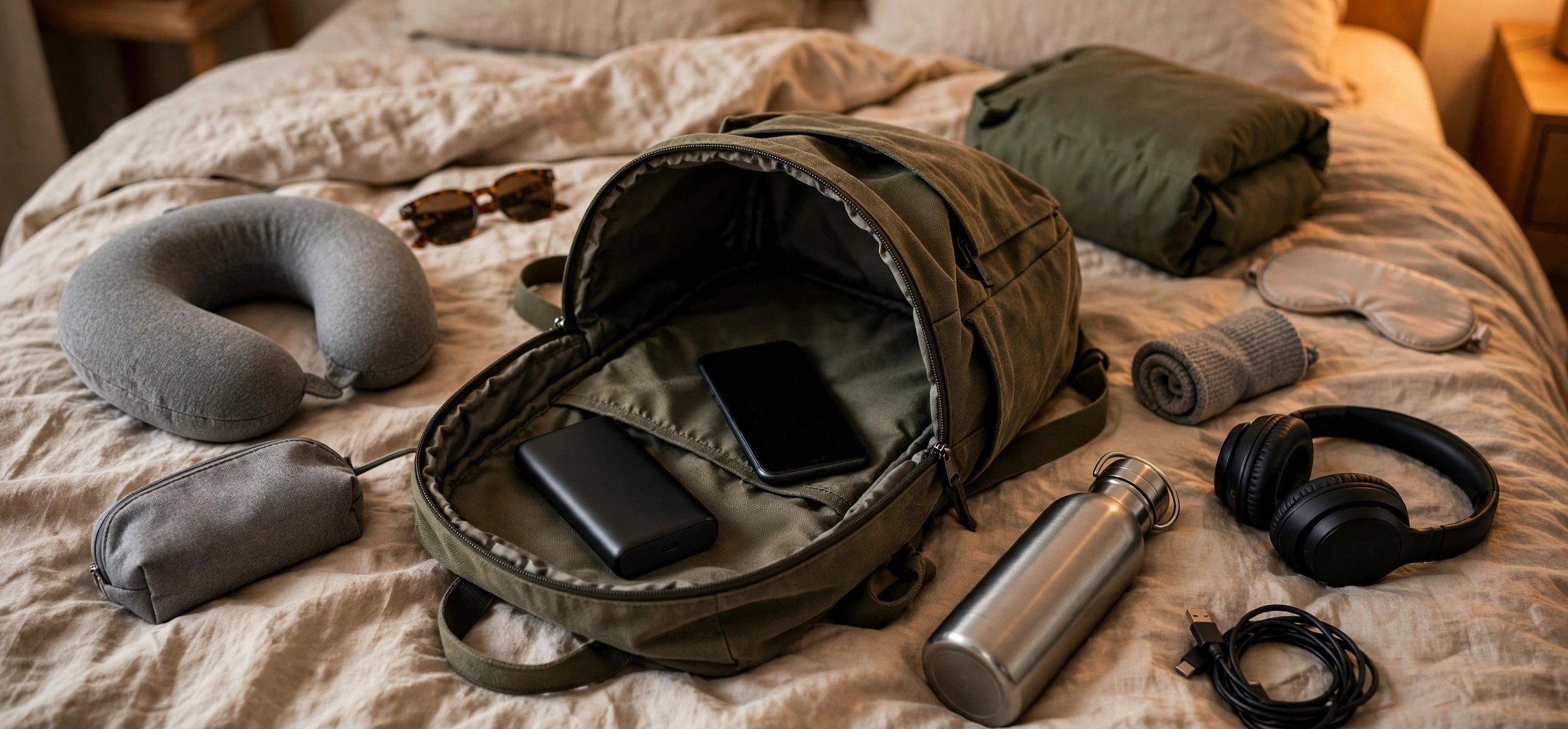
For air travel: power banks must go in cabin baggage, never checked luggage — this is an airline rule worldwide, not a suggestion. A 20000mAh (74Wh) power bank is well under the 100Wh limit that most airlines allow without approval, so you can carry it freely. Keep it easily accessible in case security wants to inspect it.
To maximise lifespan, avoid routinely draining the power bank to zero — lithium cells prefer partial cycles. Recharge it every 2–3 months even if unused, since cells slowly self-discharge and deep discharge from storage can kill them. Store at room temperature at around 50% charge if you will not use it for months. With decent care, a quality 20000mAh power bank serves reliably for 2–3 years before capacity noticeably fades.
Also note: extreme cold temporarily reduces available capacity. If you are travelling to the mountains in winter, keep the power bank in an inside pocket rather than an outer bag compartment.
Mistakes to Avoid
Buying on headline capacity alone. Two “20000mAh” power banks can deliver very different real-world charges depending on cell quality and conversion efficiency. The rated output capacity and brand reputation matter more than the big number. Ignoring your phone’s charging protocol. A 22.5W power bank does nothing special for a phone that maxes out at 18W — match the power bank to your phone, not to the spec sheet.
Choosing the cheapest listing from an unknown seller. Counterfeit power banks are among the most common fake electronics in India. The ₹200 you save can cost you a phone battery — or worse. Forgetting about recharging the power bank itself. A 20000mAh unit without fast input takes all night to refill; two-way fast charging is a daily quality-of-life feature, not a luxury.
Using cheap cables. A thin, unbranded cable can throttle even a 22.5W power bank down to slow speeds and, in bad cases, overheat. Use the cable in the box or a certified replacement. And expecting laptop charging: most sub-₹1500 20000mAh power banks cannot meaningfully charge a laptop — that needs higher wattage (45W+) and usually a bigger budget. They are phone, earbud, and smartwatch chargers; buy accordingly.
If you are kitting out for travel or long commutes, pair the power bank with a smartwatch that sips battery — our Noise vs boAt smartwatch comparison helps you pick one that will not drain your phone all day. And for students carrying tablets to classes, see our guide to the best budget tablets for online classes.
Frequently Asked Questions
How many times can a 20000mAh power bank charge my phone?
For a phone with a 5000mAh battery, expect roughly 3 to 3.5 full charges from a genuine 20000mAh power bank, after accounting for voltage conversion losses. Smaller batteries (4500mAh) will get about 3.5 to 4 charges. Claims of “4–5 charges” for a 5000mAh phone are exaggerated.
Is 22.5W fast charging worth it over 18W?
Only if your phone supports 22.5W or higher charging — otherwise both will charge your phone at the same speed. Check your phone’s maximum supported wattage first. If it supports 22.5W+, the faster power bank will top you up noticeably quicker, which matters when you are charging in short bursts between meetings.
Can I carry a 20000mAh power bank on a flight in India?
Yes. At roughly 74Wh, a 20000mAh power bank is well under the 100Wh limit most airlines set for carry-on batteries without special approval. It must go in your cabin baggage — power banks are prohibited in checked luggage on all airlines.
How do I check if a power bank is genuine?
Buy from the brand’s official store or authorised sellers, verify the BIS/ISI mark and registration number, check that the weight feels right (400–470g for genuine 20000mAh), and confirm the packaging discloses both cell and rated capacity. Register the product on the brand’s website if they offer verification.
Why does my power bank’s percentage drop even when not in use?
Lithium cells self-discharge slowly (a few percent per month), and the power bank’s own circuitry draws a tiny standby current. Losing 2–5% per month unused is normal. If it drops dramatically in days without use, the cells may be degraded or the unit faulty — claim warranty.
Can a ₹1500 power bank charge a laptop?
Generally no. Most laptops need 45W or more via USB-C Power Delivery, which sub-₹1500 20000mAh power banks do not provide. They are designed for phones, earbuds, smartwatches, and other small gadgets. Laptop-capable power banks exist but sit in a higher price tier.
Finding the best 20000mah power bank under 1500 india is not hard once you know the rules: BIS certification, honest capacity disclosure, 18–22.5W two-way fast charging, USB-C, and a trusted brand bought from an authorised seller. Get those right during a sale, and you will own a reliable travel companion for years — not a counterfeit brick that dies in three months.
For background on the technology inside, see Wikipedia’s overview of power banks.